If you had a solar panel system installed in the last few years, you’re probably happy with the savings on your energy bills. What you might not have considered is whether your panels are still performing as well as they were the day they were installed.
The answer, for most homes in Devon, is probably not — and the reason is usually dirt.
How Much Efficiency Do Dirty Panels Lose?
Research consistently shows that dirty solar panels generate less electricity than clean ones. Industry estimates suggest that a build-up of dust, grime, bird droppings, moss, and lichen can reduce panel output by between 10 and 25 per cent, depending on how soiled the panels are and how long they’ve been left.
On a typical 4kW domestic system, a 15% efficiency loss amounts to a meaningful reduction in annual generation — and with energy prices where they are, that’s a real cost.
Why Devon Is Particularly Affected
Devon’s mild, damp climate is excellent for solar panels in terms of light levels — the county gets reasonable sunshine hours despite what people sometimes assume. But that same climate creates ideal conditions for organic growth. Algae, lichen, and moss establish on panel surfaces much faster in the South West than in drier parts of the UK.
Bird activity also tends to be higher near the coast and in rural areas. A roof near the sea in Torbay, Dartmouth, or Salcombe will typically accumulate bird droppings faster than a property further inland — and bird droppings are particularly effective at blocking light.
Doesn’t Rain Clean the Panels?
It’s a common assumption, and rainfall does rinse away loose surface dust. But rain doesn’t remove dried bird droppings, lichen, or moss — all of which bond to the glass surface and require physical cleaning to remove. Rain can also leave mineral deposits (limescale) as it dries, which accumulates over time and itself reduces light transmission.
Panels installed at a shallow angle, or in a position where water pools and dries rather than running off cleanly, tend to accumulate deposits faster.
Is It Safe to Clean Solar Panels?
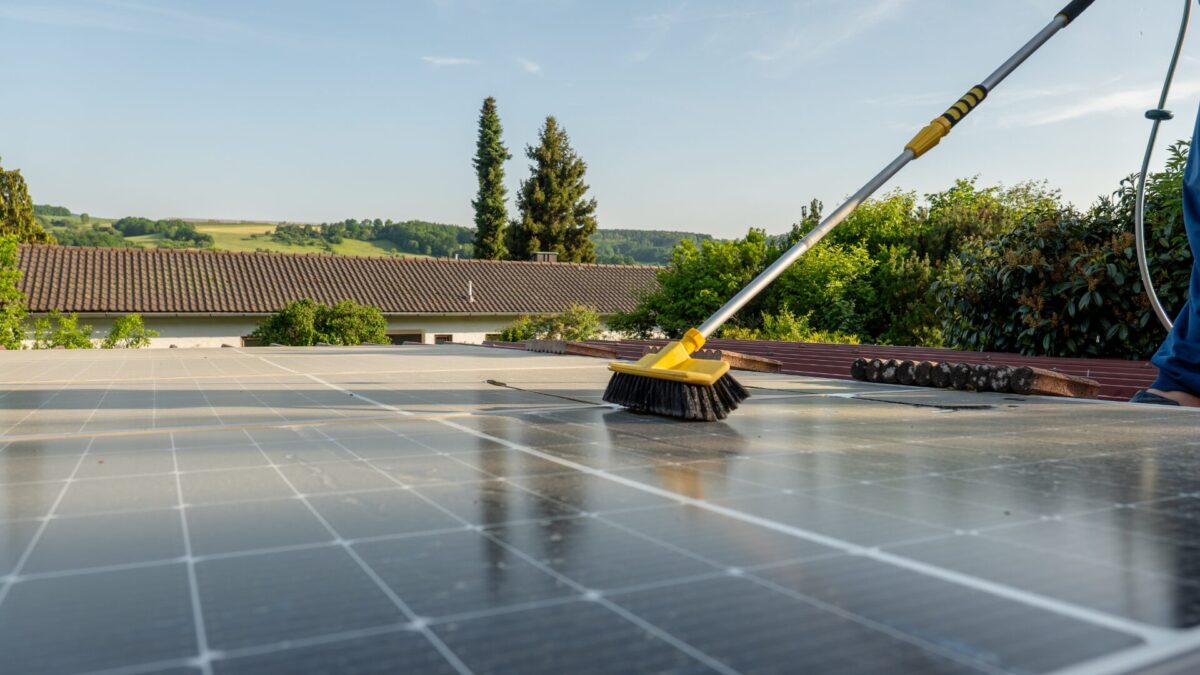
Yes — when done correctly. The important thing is to use the right technique. High-pressure washing should be avoided, as it can damage panel seals and in some cases void the manufacturer’s warranty. The correct approach uses purified (deionised) water and specialist low-pressure equipment, which cleans the glass thoroughly without leaving mineral deposits behind and without risking any damage to the panels or fixings.
It’s also a job that requires working at height, which means it should be left to someone properly equipped and insured to do so safely.
How Often Should You Have Panels Cleaned?
For most Devon properties, an annual clean is a sensible baseline. Properties in coastal locations, near trees, or with known bird activity may benefit from cleaning twice a year.
A good way to gauge whether cleaning is overdue is to check your system’s output against its historical performance data. Most inverters and monitoring apps allow you to track generation over time — if output has dropped without a corresponding change in weather patterns, soiling is the most likely explanation.
The Return on Investment
Solar panel cleaning is one of the few maintenance costs that directly pays for itself through improved energy generation. If cleaning restores even 10% efficiency to a system, the extra electricity generated over the year typically more than covers the cost of the clean.
For homeowners who export surplus electricity back to the grid through the Smart Export Guarantee, the calculation is even more straightforward.
We Clean Solar Panels Across South Devon
At Bay Exterior Cleaning, we offer professional solar panel cleaning across Torquay, Paignton, Brixham, Totnes, Newton Abbot and the surrounding areas. We use purified water systems and appropriate low-pressure techniques to clean panels safely and effectively, without any risk to the panels or their warranty.
If your panels haven’t been cleaned for a year or more — or if you’ve noticed your generation figures looking a little low — get in touch. Call us on 01803 640041 or use the enquiry form on our website and we’ll arrange a visit.